
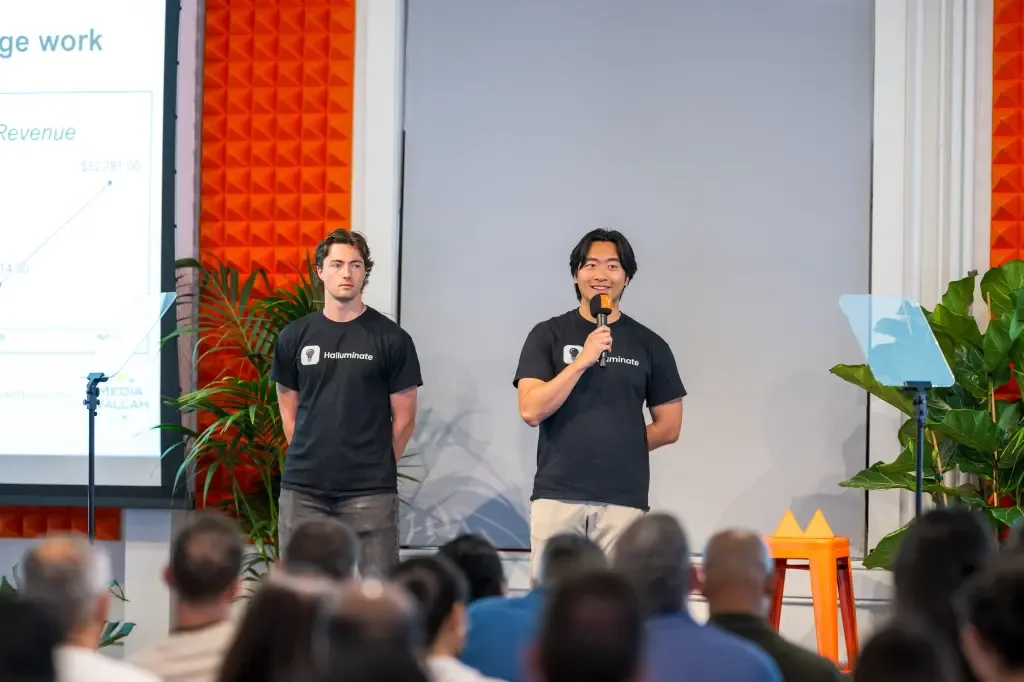
Halluminate, a nine-person San Francisco startup, has raised $30 million in a Series A led by Oak HC/FT, bringing its total funding to $38.5 million since the company was founded in 2024. The round also included Y Combinator, Orange Collective, Heavybit, and individual researchers from Anthropic, OpenAI, and Meta.
The company's business is narrow by design: it benchmarks AI models on financial tasks to find exactly where they fall short, then builds simulated training environments engineered around closing those specific gaps. CEO Jerry Wu describes the resulting systems as "verticalized data research labs," built around a single industry rather than general-purpose AI training.
Despite its small headcount, the company already counts four of the top five closed-source U.S. AI labs as paying customers, and says it's profitable, running at a mid-eight-figure annualized revenue rate. Wu has kept Halluminate's focus deliberately narrow, choosing to go deep with frontier model labs rather than expand broadly across enterprise customers.
The difficulty of the work Halluminate tests for is part of the pitch. In an August benchmark, the company ran seven frontier AI models through a simulated company-acquisition due-diligence process built around 88 tasks modeled on anonymized private-equity transactions. The highest average score among all seven models was 51 percent.
Wu argues that keeping pace with frontier labs' progress will require these training environments to roughly double in complexity every six to eight months, something he calls the "Moore's law of environments." Oak HC/FT general partner Matt Streisfeld, whose firm led the round, framed the bet in similar terms: as AI agents take on longer, more complex workflows, "testing work and specialization will really be key."